
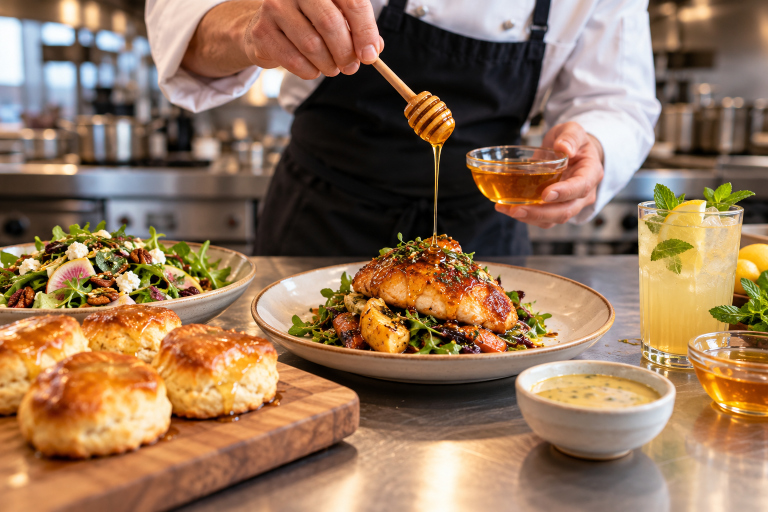
Before customers taste a product, its name, menu description, or ingredient list may already be shaping their expectations.
For restaurants, bakeries, cafés, hospitality groups, and other foodservice operations, ingredient choices can influence more than flavor. A familiar ingredient like honey can also give operators something recognizable and appealing to highlight when describing a dish, beverage, sauce, or prepared food.
Honey Is an Ingredient Customers Recognize
Foodservice menus can feature everything from familiar comfort foods to ingredients customers have never encountered before. Honey has the advantage of being widely recognizable while still offering plenty of room for creativity.
Words like honey-glazed, honey-roasted, honey-sweetened, and honey mustard immediately signal the flavor customers can expect. That familiarity can be especially useful when introducing a new menu item or putting a fresh spin on an existing favorite.
Menu descriptions matter, too. Recent restaurant-industry research cited by Toast found that many diners review menus before arriving at a restaurant and that descriptions can influence what they ultimately order.
Honey Can Support a Straightforward Ingredient Story
Customers increasingly encounter ingredient information beyond the traditional restaurant menu. Grab-and-go foods, bakery items, bottled sauces, meal kits, and other foodservice products may all include labels or ingredient statements.
Honey gives operators a familiar ingredient name that can be easy for customers to understand. For businesses that want straightforward formulations and recognizable ingredients, honey can support the overall product story.
However, operators should be thoughtful about the claims they make. “Clean label” has no universally established regulatory definition, and the presence of honey alone does not automatically make a product clean label. Accurate ingredient representation remains important. The FDA also provides specific guidance on properly labeling honey and honey products.
Honey Creates Opportunities for More Descriptive Menu Items
Honey also brings versatility to menu development.
Its sweetness can be paired with savory, spicy, smoky, tangy, or acidic flavors, creating opportunities across appetizers, entrées, beverages, baked goods, dressings, sauces, and desserts. Different honey varieties can also add their own flavor, aroma, and color.
Think about the difference between calling something simply “fried chicken” and describing it as “hot honey fried chicken,” or offering a basic vinaigrette versus a “honey citrus vinaigrette.” Honey becomes part of the sensory description and helps communicate what makes the item distinctive.
That versatility can help foodservice teams create menu concepts that feel familiar without being ordinary.
Ingredient Integrity Matters When Honey Is Part of the Story
Honey’s marketing value depends on the product delivering what the description promises.
If honey is prominently featured in a menu item or product name, operators should consider whether the formulation supports that positioning. Using honey language or imagery while relying primarily on other sweeteners can create a disconnect between the product story and the actual formulation.
That is one reason authenticity and ingredient integrity matter. A strong honey story starts with real honey and a supplier that can provide transparency into its sourcing.
Find the Right Honey for Your Foodservice Application
Whether you are developing a signature sauce, beverage, baked good, dressing, dessert, or another menu item, honey can contribute both functional value and a recognizable ingredient story.
At GloryBee, we work with commercial customers to provide authentic, traceable honey for a variety of food applications. Our team can also provide research and development support to help you determine how honey can work within your application.
Talk to a Honey Expert to discuss your foodservice needs and find the right honey for an application that delivers on both flavor and your product story.